Will AI Agents Replace Human Jobs by 2030? The Brutal Truth for Professionals
The question is no longer “in case” AI will alter the workforce, but “how quick.” As of 2026, we have moved past the time of straightforward chatbots into the age of Independent AI Agents—systems competent of thinking, utilizing apparatuses, and executing complex workflows without consistent human oversight (Boston Counseling Bunch, 2025).
By 2030, the worldwide AI advertise is anticipated to approach $2 trillion, up from $100 billion in 2025 (Rita et al., 2025). This exponential development is constraining a radical reimagining of each proficient division. But will it result in a jobless future or a efficiency revolution?
1. The 2030 Viewpoint: Relocation vs. Augmentation
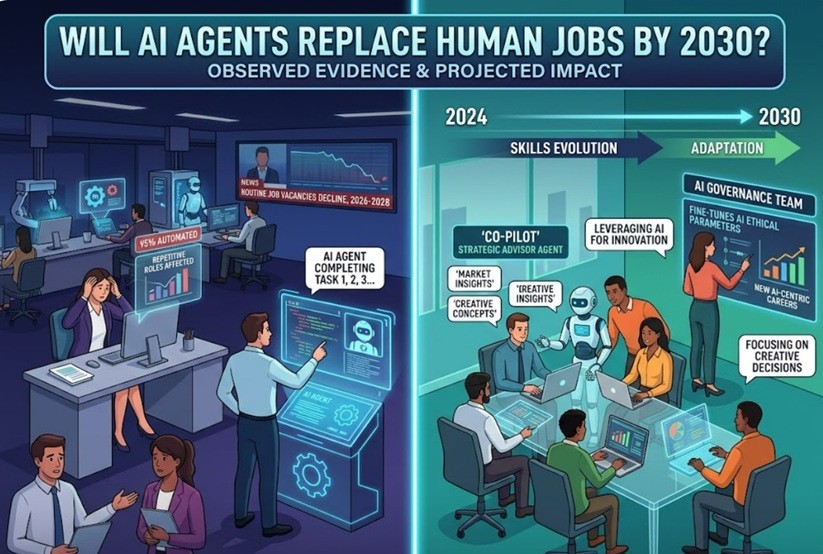
The affect of AI on the labor showcase is bifurcated. Whereas total work misfortunes may not be as disastrous as once dreaded, the micro-evidence uncovers critical disturbance at the passage and mid-levels (Harvard Sprint, 2026).
Who is Most at Risk?
Research demonstrates that schedule cognitive tasks—the bread and butter of junior proficient roles—are the most vulnerable.
- Software Improvement: Entry-level coding parts have seen a 14% to 41% decrease in work postings between 2022 and 2024 as AI coding operators computerize schedule investigating and boilerplate creation (Wildernesses in Human Flow, 2026).
- Customer Back: AI conversational associates are no longer fair replying FAQs; they are overseeing whole bolster lifecycles, essentially expanding efficiency among less experienced laborers whereas diminishing the require for expansive human groups (Brynjolfsson et al., 2023).
- Marketing & Substance: These divisions have seen a 2% to 21% diminishment in online labor advertise postings as operators take over SEO, essential copywriting, and social media administration (Wildernesses in Human Elements, 2026).
2. The “Reimagination” Impact: Unused Parts Emerging
While a few parts disappear, others are being “reimagined.” In higher instruction, for occurrence, the conventional address show is moving toward AI-led personalized coaching. Future teachers may spend less time addressing and more time “direction” AI mentors on how to guide understudies (Canadian Open Approach, 2026).
High-Demand Abilities for 2030:
- AI Administration & Morals: Overseeing the dangers of mistake, security, and bias.
- Socio-Technical Integration: The capacity to weave AI operators into existing human workflows.
- System Plan: Moving from “doing the work” to “architecting the framework” that does the work.
3. Financial Affect: The Efficiency Paradox
Economists are right now debating the AI Efficiency Conundrum. In spite of enormous investment—with hyperscalers like Google and Microsoft investing an assessed $527 billion on AI foundation in 2026—macroeconomic efficiency development remains unassuming (Goldman Sachs, 2025).
4. Why AI Specialists Won’t “Murder” All Jobs
Despite the computerization of errands, numerous specialists contend that human-in-the-loop frameworks stay fundamental. High-level decision-making, empathy-driven care, and complex physical errands (like specialized development or surgery) still confront critical specialized and administrative obstacles (NBER, 2026).
As Jamie Dimon, CEO of JPMorgan Chase, famous, AI will kill particular assignments, but it will too make totally unused categories of work that we cannot however characterize (Gerut, 2025). The key for laborers is adjustment. Those who illustrate “AI-augmentation capabilities” are as of now seeing a 15% to 22% wage premium compared to their non-AI partners (Wildernesses in Human Elements, 2026).
Conclusion: The Survival Direct for 2030
By 2030, AI operators will likely be your colleagues or maybe than your replacements—provided you advance. The move will be rough for junior parts and routine-heavy divisions, but for the proactive proficient, AI speaks to a gigantic use tool.
The foot line: AI won’t take your work, but a human utilizing an AI specialist fair might.