Physical AI Explained: The Next Evolution After ChatGPT
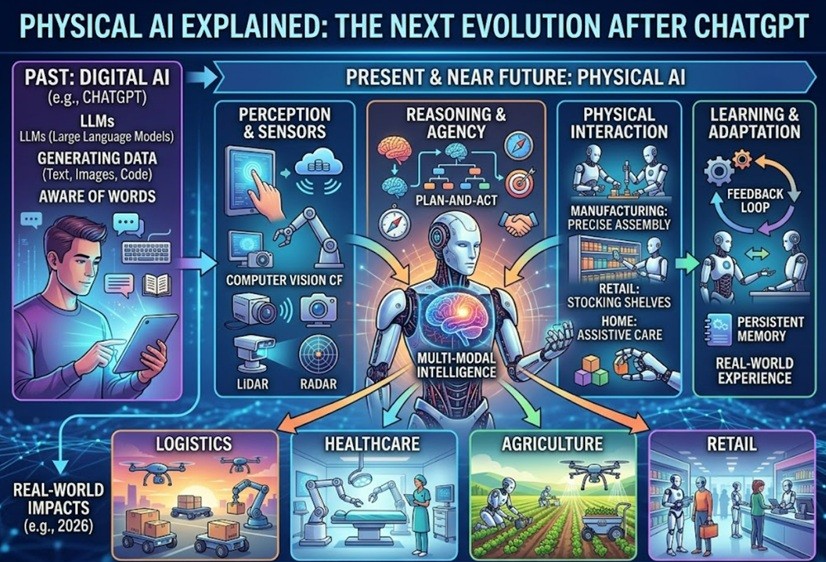
The entry of ChatGPT checked the minute AI got to be a family title, but whereas expansive dialect models (LLMs) have aced the world of “bits”—text, pictures, and code—the another wilderness lies in the world of “molecules”. We are entering the period of Physical AI.
If Generative AI is the “brain” in a advanced bump, Physical AI is that brain at last picking up a body. It is the integration of high-level thinking with physical frameworks that can see, move, and connected with the genuine world independently. By 2026, specialists foresee this move will rethink businesses from retail to overwhelming manufacturing.
What is Physical AI?
Physical AI alludes to counterfeit insights frameworks that work in and connected with the physical world or maybe than existing exclusively in computerized situations. It speaks to the merging of mechanical technology, machine learning, and progressed sensor innovation. Not at all like conventional computerization, which takes after inflexible, pre-programmed enlightening, Physical AI employments models like LLMs to see their environment, reason through complex errands, and adjust to changing conditions in real-time.
Key Components of Physical AI
To transition from a chatbot to a physical agent, these systems rely on several critical technologies:
- Sensor Fusion: Combining data from LiDAR, cameras, radar, and motion sensors to build a comprehensive map of the environment.
- Edge Computing: Processing data locally on the device to minimize latency, which is vital for safety in dynamic environments.
- Actuators and Control Systems: The “muscles” that allow the AI to execute precise movements, from delicate assembly to heavy lifting.
- Persistent Memory: The ability to learn from past physical interactions to improve future performance.
The Challenge of “Physical Reality”
Training Physical AI is significantly harder than training software-based AI for a few reasons:
- Expensive Data: You cannot simply scrape the internet for physical interaction data; a robot must physically move to learn.
- Continuous Time: AI in the real world cannot “pause” to think; small delays in perception-to-action loops can lead to failures or accidents.
- Complex Physics: Factors like gravity, friction, and torque are infinitely harder to model perfectly in a digital simulation than they are to encounter in reality.
Real-World Applications in 2026
We are moving from pilot programs to full-scale production in several key sectors.
1. “Phygital” Retail
Retailers are deploying “AI Ambassadors”—robots that navigate stores to assist customers. Systems equipped with computer vision track inventory in real-time, while “intelligent checkout” allows customers to walk out without scanning, as the Physical AI handles the transaction automatically at the exit.
2. Autonomous Logistics and Warehousing
Autonomous Mobile Robots (AMRs) are evolving beyond simple transport. By 2026, they are performing complex “pick, stow, and touch” operations, handling delicate materials with human-like dexterity.
3. Vertical Industrial
AIInstead of general-purpose robots, manufacturers are turning to Task-Specific AI. These are out-of-the-box systems pre-trained for specific roles like AI welding, AI sanding, or AI precision assembly, cutting down setup time significantly.
4. Healthcare and Elder Care
Physical AI is entering hospitals to assist in minimally invasive surgeries and medication delivery. In the home, AI-enhanced robotics are beginning to handle unstructured tasks like personalized elder care, which requires both physical gentleness and high-level social reasoning.
Impact on the Workforce
The rise of Physical AI will be more transformative than previous industrial revolutions.
- Safety and Health: Wearable AI sensors can monitor workers in real-time to prevent musculoskeletal injuries or exposure to toxic substances.
- Job Transformation: While AI will replace repetitive manual labor in warehouses and assembly lines, it creates new demand for “Robotics-as-a-Service” (RaaS) providers and AI infrastructure managers.
- The Hybrid Workforce: The future is not “humans vs. robots,” but a synergistic environment where humans oversee fleets of autonomous agents.
The Road Ahead:
2026 and Beyond The physical AI market is projected to skyrocket, growing from $1.50 billion in 2026 to over $15 billion by 2032. The “silent revolution” driving this isn’t just better hardware, but advanced math and imitation learning models that allow robots to learn by observing humans.
As we move past the novelty of AI chatbots, the integration of intelligence into physical forms will be the defining technological shift of the decade. For businesses, adopting Physical AI is no longer a sci-fi experiment—it is a competitive imperative.