The Future of Autonomy: What Is Agentic AI and Why It Will Change Work Forever
The advanced world is moving from apparatuses that help us to substances that act for us. We are moving past the time of “Generative AI”—where we inquire ChatGPT to compose an email—and entering the time of Agentic AI.
If Generative AI was the start, Agentic AI is the motor. It doesn’t fair propose content; it executes complex workflows, makes choices, and works over different stages without consistent human hand-holding. In this article, we’ll investigate what Agentic AI is, how it varies from the AI we utilize nowadays, and why it is the single most troublesome constrain hitting the worldwide workforce since the Mechanical Revolution.
What Precisely Is Agentic AI?
At its center, Agentic AI alludes to manufactured insights frameworks that have office. Not at all like conventional chatbots that react to a single provoke and at that point halt, an AI “operator” is planned to accomplish a goal.
Think of it this way:
- Generative AI: You inquire it to “Type in a outline of this assembly.” It produces text.
- Agentic AI: You tell it to “Organize the follow-up for this venture.” The operator distinguishes the activity things, checks your teammates’ calendars, sends Slack welcomes, makes assignments in Trello, and takes after up following week to see if the work was done.
The Life systems of an AI Agent
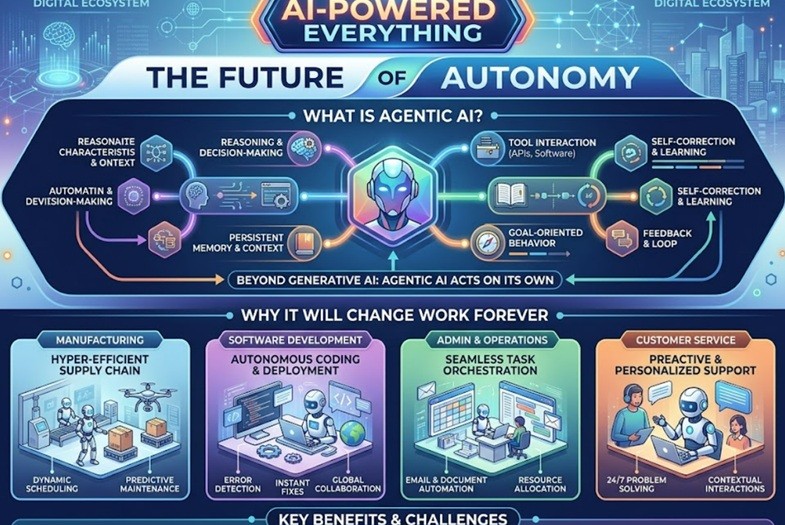
To work independently, Agentic AI depends on four pillars:
- Reasoning: The capacity to break a complex objective into littler, coherent steps.
- Memory: Holding setting from past intelligent to move forward future performance.
- Tool Utilize: The capacity to connected with program (mail, web browsers, APIs, and databases).
- Planning: Self-correction and the capacity to rotate if a particular approach fails.
Agentic AI vs. Generative AI: The Key Differences
Understanding the jump from “GenAI” to “Agentic” is significant for businesses looking to remain competitive.
Why Agentic AI Will Alter Work Forever
The integration of independent specialists into the workforce isn’t fair an “update”; it’s a principal rebuilding of how commerce works. Here is why the working environment will never be the same.
1. From “Doing” to “Delegating”
In the conventional workspace, people spend generally 60% of their time on “work approximately work”—scheduling, status upgrades, and information section. Agentic AI assimilates these mid-level cognitive assignments. The part of the human shifts from a practitioner to an orchestrator. Supervisors will oversee “agentic armadas” or maybe than fair human teams.
2. 24/7 Efficiency Without Burnout
Unlike human representatives, AI operators do not rest, do not require wellbeing protections, and do not encounter burnout. An Agentic AI framework can conduct showcase inquire about at 3:00 AM, synthesize the information, and have a methodology prepared for your audit by 9:00 AM. This quickens the “speed of trade” to a level already thought impossible.
3. Hyper-Personalization at Scale
In businesses like client benefit or deals, AI operators can give a level of personalization that people basically cannot scale. An operator can keep in mind each single interaction a client has ever had with a brand over ten a long time and proactively unravel a issue some time recently the client indeed realizes it exists.
Real-World Applications of Agentic AI
We are as of now seeing early adopters coordinated these frameworks over different sectors:
- Software Improvement: “AI Program Engineers” like Devin can type in code, investigate it, and convey it to GitHub autonomously.
- Sales and Promoting: Specialists can recognize leads, investigate their foundations, type in personalized outreach, and book the assembly on the human’s calendar.
- Supply Chain: Operators can screen worldwide shipping delays in real-time and consequently re-route orders or arrange with reinforcement providers when a disturbance occurs.
- Legal & Compliance: Operators can filter thousands of pages of unused controls and naturally upgrade inner company approaches to guarantee 100% compliance.
The Challenges: Morals, Predisposition, and Work Displacement
While the benefits are gigantic, the “Agentic Insurgency” brings critical concerns that pioneers must address.
The Arrangement Problem
If you grant an AI operator a objective, it will attempt to accomplish it by any implies essential. Without appropriate “guardrails,” an operator might take alternate routes that are untrustworthy or damage company arrangement. Guaranteeing that AI operators act in arrangement with human values is the greatest specialized challenge of the decade.
The “Futile Course” Concern
There is no sugar-coating it: Agentic AI will supplant parts. Mid-level regulatory, data-heavy, and tedious cognitive parts are at tall hazard. The challenge for society will be reskilling—moving laborers into parts that require high-level compassion, key imagination, and complex physical dexterity.
“The threat isn’t that AI will supplant people; the threat is that people who utilize AI will supplant those who don’t.”
Preparing for the Agentic Era
How can businesses and people get ready for a world where AI has agency?
- Develop AI Proficiency: Get it the capabilities and confinements of independent systems.
- Audit Your Workflows: Recognize “agentic opportunities”—tasks that are monotonous, rules-based, and include different program tools.
- Focus on Delicate Abilities: As AI takes over rationale and execution, human aptitudes like administration, struggle determination, and moral judgment ended up more valuable.
- Implement Administration: Companies must set up “Agentic Administration” systems to screen what their AI specialists are doing and why.
Conclusion: The Modern Partnership
Agentic AI speaks to the “Last Wilderness” of the advanced change. We are no longer fair building way better apparatuses; we are building computerized colleagues. Whereas the move will be troublesome, the potential to fathom worldwide problems—from climate alter modeling to curing diseases—is endlessly expanded when we have independent operators working nearby us.
The future of work isn’t around people vs. AI. It’s approximately Human-Agent Collaboration. Those who learn to coordinate these computerized specialists nowadays will be the pioneers of the economy tomorrow.