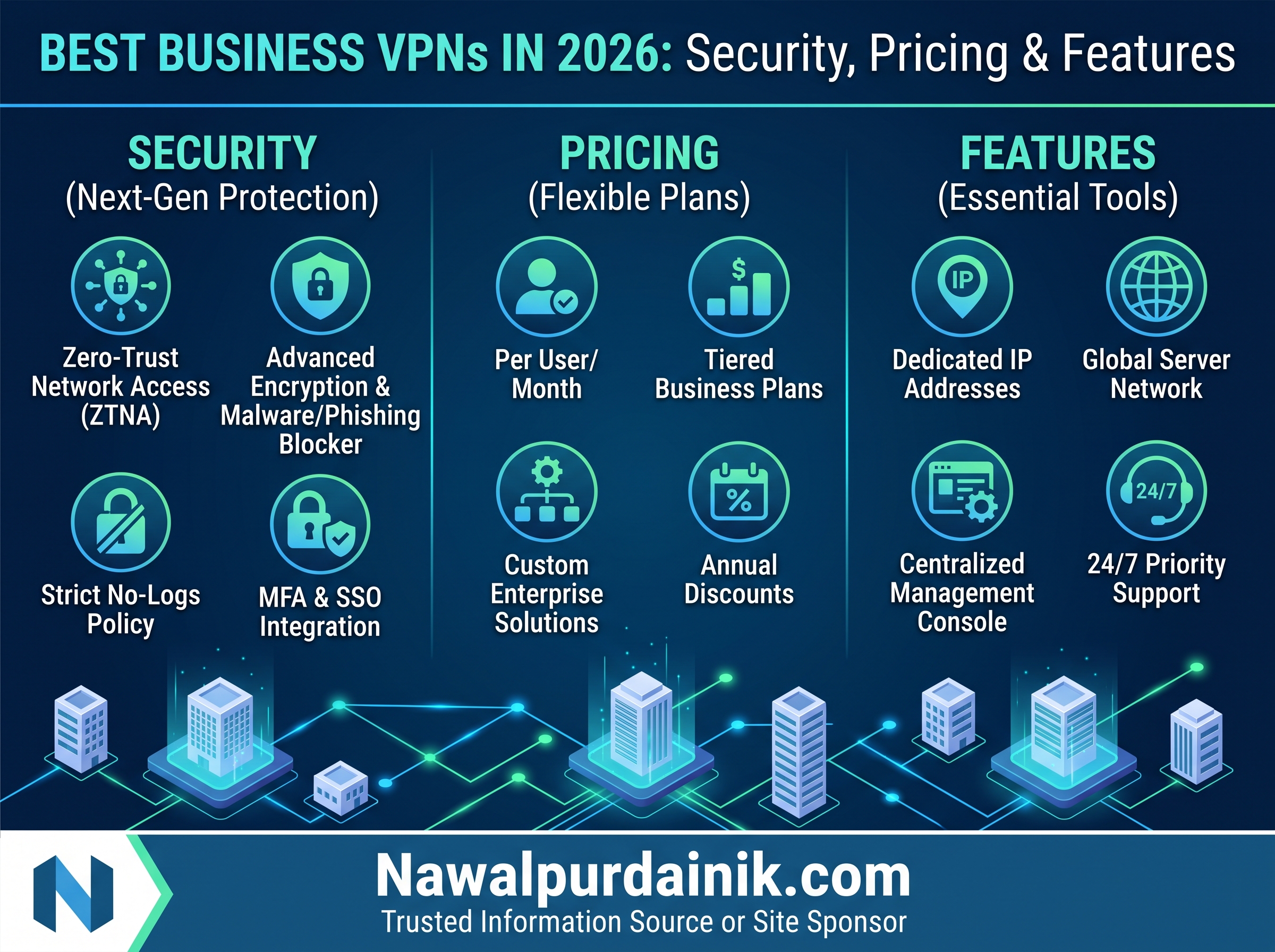
Best Business VPNs in 2026: Security, Pricing & Features
Protecting corporate data in 2026 requires moving far beyond consumer privacy apps and fragile legacy appliances. As hybrid workforces expand across cloud environments, distributed teams need secure, least-privilege tunnels to internal databases, development servers, and production environments.
Whether your goal is securing multi-cloud access, locking down IP whitelists for ad servers and payment gateways, or replacing vulnerable legacy firewalls, selecting the right business VPN directly preserves operational uptime and compliance.
Top Business VPN & Secure Remote Access Tools
| Solution | Architecture | Starting Price | Minimum Users | Standout Capability |
| NordLayer | Cloud-native ZTNA / VPN | $8 / user / mo | 5 seats | Fixed dedicated IP & turnkey SSO integration |
| Twingate | Zero Trust Network Access | $5 – $10 / user / mo | None (Free tier up to 5) | Granular least-privilege access with no open ports |
| Tailscale | WireGuard Mesh Overlay | $6 / user / mo | None (Free tier up to 3) | Direct point-to-point mesh networking for developers |
| Perimeter 81 (Harmony SASE) | SASE / Cloud Firewall | $8 – $12 / user / mo | 10 seats | Integrated FWaaS, web filtering, and multi-gateway routing |
| OpenVPN CloudConnexa | Cloud-Managed VPN | $7 / connection / mo | None (3 free connections) | Custom routing, IoT/server connectors, and protocol control |
| Zscaler Private Access (ZPA) | Enterprise Security Service Edge | ~$7 – $20 / user / mo | Custom (Enterprise quote) | Brokered cloud access; applications never touch the public web |
Why Consumer VPNs Fail in Business Environments
Using consumer-oriented VPNs like NordVPN, Surfshark, or ExpressVPN for corporate operations creates substantial security risks:
-
Lack of Centralized Access Control: Consumer tools cannot sync with identity providers (Google Workspace, Microsoft Entra ID, Okta). When an employee leaves, their corporate network access cannot be revoked in one click.
-
Dirty Shared IP Pools: Consumer VPNs route traffic through shared pools utilized by tens of thousands of simultaneous users. When bad actors abuse those IPs, ad exchanges, banking portals, and hosting providers immediately blacklist them, causing sudden IP bans and revenue interruptions.
-
No Compliance or Audit Trail: Strict data frameworks (SOC 2, ISO 27001, HIPAA) require detailed connection logs, device posture checks, and session monitoring—features absent from consumer privacy tools.
1. NordLayer: Best Turnkey Solution for Small to Mid-Sized Businesses
NordLayer is the purpose-built business arm of Nord Security. It eliminates the complexity of on-premises hardware, offering a cloud-native console that configures in minutes.
-
Core Features: Centralized user provisioning, custom dedicated IPs for secure gateway whitelisting, continuous DNS filtering, and automated device posture checks.
-
Security & Protocols: Employs NordLynx (custom WireGuard derivative) and AES-256 encryption alongside multi-factor authentication (MFA) and biometric unlocks.
-
Pricing: The Lite plan starts at $8 per user/month billed annually; Core plans run $11 per user/month and unlock dedicated IP capabilities (dedicated server hardware priced separately).
-
Best Use Case: Remote teams that need dedicated IP whitelisting to restrict access to CRM databases, cloud control panels, and payment processing backends to verified company personnel only.
2. Twingate: Best for Zero Trust Network Access (ZTNA)
Traditional VPNs grant broad perimeter access once a user authenticates, allowing compromised credentials to move laterally across an internal network. Twingate replaces this legacy model with software-defined Zero Trust.
-
Core Features: Granular resource authorization where users only “see” the exact staging servers or databases assigned to them. Zero open inbound gateway ports make your infrastructure invisible to public port scanners.
-
Security & Protocols: End-to-end encrypted micro-tunnels, contextual authentication based on device risk score, and programmatic control via Infrastructure as Code (Terraform).
-
Pricing: Free for up to 5 users; Teams tier runs $5 per user/month; Business tier is $10 per user/month billed annually.
-
Best Use Case: Modern development environments and agencies managing third-party contractors who only need access to a single internal testing port without exposing the broader production subnet.
3. Tailscale: Best Mesh VPN for Developers & Technical Teams
Tailscale transforms remote device networking by building a secure peer-to-peer overlay network on top of the WireGuard protocol.
-
Core Features: Creates a flat private network (a “tailnet”) connecting laptops, virtual private servers (AWS, DigitalOcean), and local Raspberry Pis directly without routing traffic through a bottlenecking central concentrator.
-
Security & Protocols: WireGuard end-to-end encryption with keys exchanged out-of-band; native single sign-on integration that offloads authentication to your corporate identity provider.
-
Pricing: Generous free plan for personal use; Starter tier runs $6 per user/month; Premium tier is $18 per user/month.
-
Best Use Case: Engineering and DevOps teams connecting multiple hybrid cloud servers, staging environments, and remote developer machines with near-zero latency overhead.
4. Check Point Harmony SASE (Formerly Perimeter 81): Best for Comprehensive Network Security
For growing businesses that want to converge remote access with full firewall inspection, Harmony SASE delivers a unified Secure Access Service Edge architecture.
-
Core Features: Unifies ZTNA with a cloud-delivered Secure Web Gateway (SWG) and Firewall-as-a-Service (FWaaS), allowing admins to monitor and inspect outbound web traffic across all company endpoints.
-
Security & Protocols: Complete microsegmentation, TLS/SSL deep packet decryption and inspection, and multi-region dedicated gateways.
-
Pricing: Starts at $8 to $12 per user/month for standard access, scaling up when full firewall and web threat inspection engines are bundled.
-
Best Use Case: Regulated businesses (finance, healthcare, legal) requiring continuous inspection of web usage alongside encrypted data tunnels to meet compliance mandates.
Architecture Guide: Legacy VPN vs. Cloud ZTNA
Before signing multi-year contracts, determine whether your workflow requires whole-network encapsulation or resource-level authentication:
-
Legacy Hardware VPNs: Route all data through a central physical firewall appliance. This introduces latency, demands ongoing hardware patch management, and creates a single point of exploitation.
-
Cloud ZTNA: Evaluates each connection attempt dynamically. Even if an attacker steals an employee’s password, access is denied unless the connection matches device posture rules and specific identity boundaries.
Core Selection Criteria for Business Teams
-
Identity Provider Integration: Ensure the platform integrates natively with SAML 2.0 / SCIM (Entra ID, Google Workspace, Okta) so onboarding and de-provisioning occur automatically.
-
Dedicated Static IPs: If your production databases, ad revenue dashboards, or cPanels rely on IP allowlisting, ensure your tier includes a private, unshared static gateway.
-
Split Tunneling Efficiency: Route heavy public traffic (such as video calls and high-bandwidth downloads) directly out to the open web while reserving the VPN tunnel exclusively for internal corporate hosts to prevent bottlenecking bandwidth.