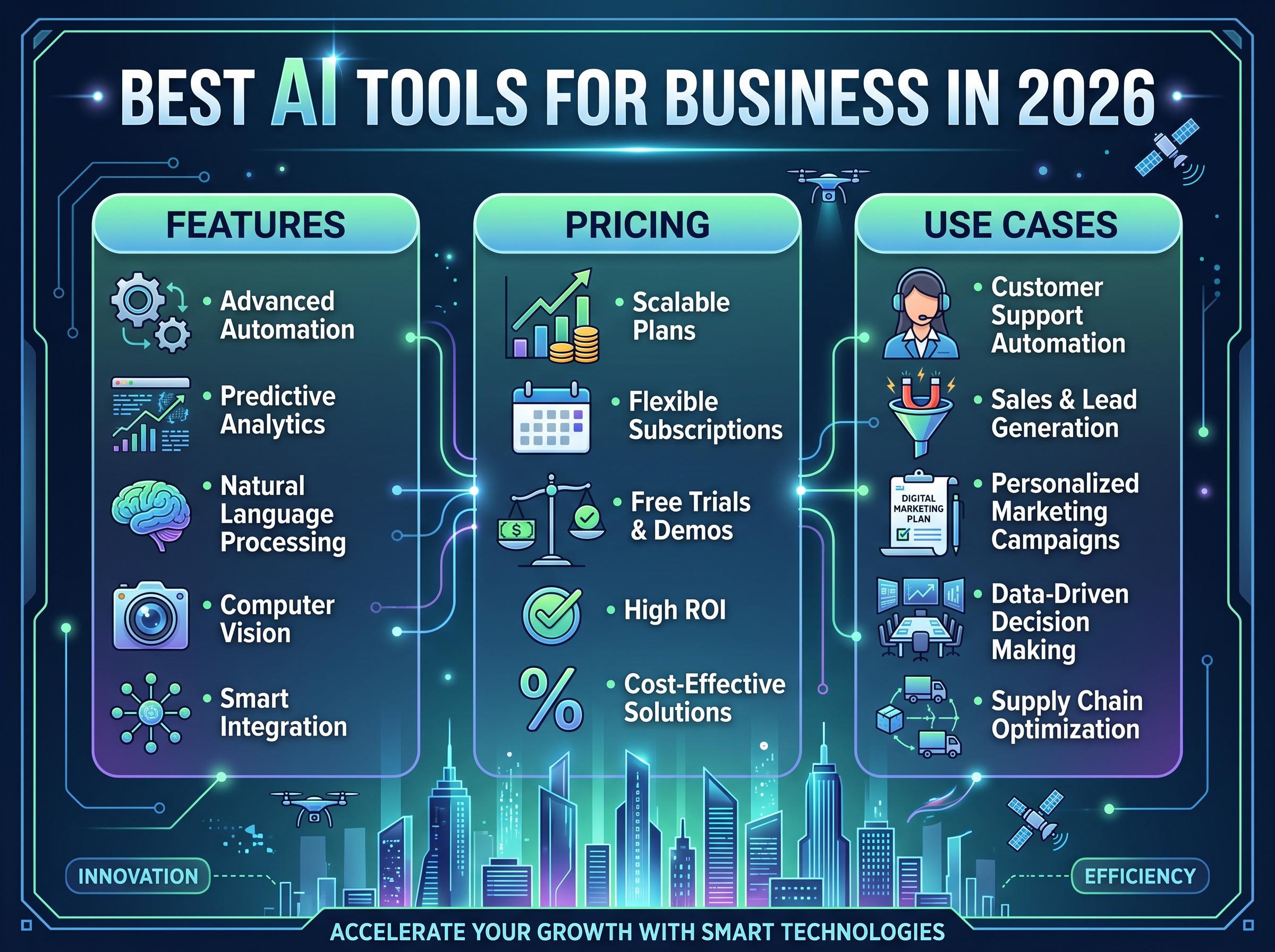
Best AI Tools for Business in 2026: Features, Pricing & Use Cases
Selecting the right enterprise AI stack in 2026 has shifted from experimental novelty to operational necessity. Organizations are moving away from disconnected chatbots and investing in integrated agentic systems, context-aware productivity suites, and custom automation infrastructure.
Whether the goal is reducing customer support overhead, accelerating software delivery, or unifying siloed enterprise knowledge, here is a detailed breakdown of the leading AI platforms driving commercial ROI this year.
Enterprise AI Tech Stack Comparison
| Platform | Core Category | Starting Price | Best For | Standout Advantage |
| Microsoft 365 Copilot | Workspace Productivity | $30 / user / mo | Windows & Office enterprises | Native Microsoft Graph data integration |
| Claude Team & Enterprise | Analytical Reasoning | $20 / user / mo | Legal, finance, complex analysis | Massive context retention & low hallucination rates |
| ChatGPT Enterprise | Multi-purpose General AI | $25 / user / mo (Team) | Cross-departmental tasks & ideation | Multimodal capabilities & custom GPT ecosystem |
| Salesforce Agentforce | Sales & CRM Automation | ~$0.10 / action | High-volume sales & service operations | Autonomous agents executing tasks directly in CRM |
| Cursor / Claude Code | Developer Velocity | $20 / user / mo | Software engineering teams | Full-codebase context and automated refactoring |
| Intercom Fin | Customer Experience | $0.99 / resolution | SaaS customer support | Outcome-based pricing with zero hallucination guardrails |
| Make & Zapier Central | Workflow Orchestration | $9 – $20 / mo | Cross-app automated logic | Multi-step agentic execution across thousands of APIs |
1. Microsoft 365 Copilot: Best for Office-Centric Workspaces
Microsoft 365 Copilot embeds generative models directly into Outlook, Teams, Word, Excel, and PowerPoint. Grounded in the secure Microsoft Graph, it queries organizational emails, chat history, and SharePoint documents to automate routine work.
-
Key Features: Real-time Teams meeting synthesis with sentiment tracking; dynamic Excel modeling using natural language; cross-application enterprise search via Microsoft 365 Chat.
-
Commercial Pricing: $30 per user per month (annual billing required), applied on top of an eligible Microsoft 365 Business Standard/Premium or Enterprise base license.
-
Primary Use Case: Accelerating internal communications and reporting. A sales director can prompt Copilot to extract metrics from a slide deck, cross-reference them with regional email updates, and generate a standardized briefing in seconds.
2. Claude (Anthropic): Best for Complex Analysis & Strategic Reasoning
Claude excels at parsing dense technical, legal, and financial literature with exceptional fidelity and low hallucination rates. Powered by extended context windows, Claude handles intricate instructions without losing long-range coherence.
-
Key Features: Industry-leading prompt adherence, code synthesis, native document upload/parsing (PDFs, spreadsheets, contracts), and strict enterprise privacy boundaries (zero training on enterprise data).
-
Commercial Pricing: Claude Team starts at $20 per seat per month (minimum 5 seats). Enterprise tiers offer custom single sign-on (SSO), higher concurrency limits, and expanded API quotas.
-
Primary Use Case: Compliance auditing and strategic research. Financial analysts use Claude to run parallel comparative analyses across competing 10-K SEC filings to identify nuanced reporting shifts and risk factors.
3. Salesforce Agentforce: Best for Autonomous CRM & Revenue Operations
Salesforce has expanded beyond conversational copilots to autonomous execution with Agentforce. Operating on the Atlas Reasoning Engine, it analyses customer interactions and triggers back-office actions across sales, marketing, and customer support without human hand-holding.
-
Key Features: Deep data grounding within Salesforce Data Cloud; dynamic multi-turn resolution for billing and logistics inquiries; real-time lead qualification and automatic pipeline routing.
-
Commercial Pricing: Outcome-based hybrid structure starting around $2 per conversation or $0.10 per autonomous action via Flex Credits.
-
Primary Use Case: Autonomous tier-1 support and outbound pipeline generation. When a high-intent prospect fills out a contact form, Agentforce verifies company firmographics, updates the lead score, answers inbound product questions, and books an executive demo directly on an AE’s calendar.
4. Intercom Fin: Best for Autonomous Customer Service
Fin by Intercom is a benchmark for support teams seeking to scale resolution volume while controlling staffing costs. Unlike basic scripted chatbots, Fin interprets complex inquiries, seeks clarification, and relies solely on verified internal knowledge bases to prevent inaccurate answers.
-
Key Features: Instant omnichannel support across live chat, email, and WhatsApp; seamless escalation to human representatives with full context summaries; automated multilingual translation.
-
Commercial Pricing: Performance-based pricing at $0.99 per successful resolution, eliminating the cost barrier of unhelpful bot interactions.
-
Primary Use Case: High-growth e-commerce and SaaS support deflection. By handling tier-1 inquiries—such as refund requests, subscription upgrades, and technical troubleshooting—Fin routinely resolves 50% or more of inbound support volume without human intervention.
5. Cursor & Claude Code: Best for Software Engineering Velocity
AI-assisted programming has transitioned from line-level auto-complete to full-repository management. Cursor (a purpose-built VS Code fork) and specialized command-line tools like Claude Code allow developers to refactor legacy code, debug services, and build features using plain English.
-
Key Features: Whole-codebase vector indexing; inline multi-file editing; automatic terminal error correction; instant documentation lookups.
-
Commercial Pricing: Cursor Pro starts at $20 per user per month, with Business plans available at $40 per user per month featuring privacy compliance and central seat management.
-
Primary Use Case: Rapid prototyping and reducing legacy tech debt. Engineering teams can ingest multi-thousand-line legacy codebases and issue instructions to migrate endpoints, draft unit tests, and resolve security vulnerabilities in hours rather than weeks.
6. Make & Zapier: Best for Cross-Application Workflow Automation
Standalone AI models are only as valuable as their access to your operating stack. Modern automation platforms combine traditional API orchestration with embedded large language models to process unstructured data into structured outputs.
-
Key Features: Thousands of pre-built app integrations (Slack, Google Drive, HubSpot, Stripe); visual conditional logic builders; native AI transformation steps for automated categorization and extraction.
-
Commercial Pricing: Make plans begin at $9 per month; Zapier Starter begins at $19.99 per month, scaling based on task execution volume.
-
Primary Use Case: Unstructured invoice and document processing. Businesses deploy automations that extract inbound PDF invoices from email attachments, parseline items into standardized JSON, route the approval request to Slack, and log the transaction into NetSuite automatically.
How to Calculate ROI and Avoid AI Shelfware
Adopting AI requires clear cost-benefit boundaries. Many organizations accumulate redundant subscriptions across departments, resulting in unnecessary overhead.
-
Measure Outcome-Based Metrics: Rather than tracking raw log-in counts, evaluate time saved per ticket closed, lead conversion acceleration, or code review cycle speed.
-
Audit Ecosystem Lock-in: Consolidate where possible. If your workforce runs on Microsoft 365 or Google Workspace, leverage their integrated assistants before purchasing third-party productivity add-ons.
-
Establish Data Governance First: Ensure selected tools meet enterprise privacy guidelines, including SOC 2 Type II certifications, HIPAA compliance (if handling health records), and explicit zero-data-retention agreements for AI model training.